For IT professionals who want to keep learning, the O’Reilly “animal” books are no strangers. I, for one, am always intrigued by their cover choices. Are they deliberate, like it has to do with the specific book, or do they stem from an author preference?
After spending a day scoping for ducks in the Stanwood area recently, I visited their Sno-Isle Library branch and was pleasantly surprised to see these books. Of course, being a birder and someone interested in distributed systems, I picked up ALL of them.
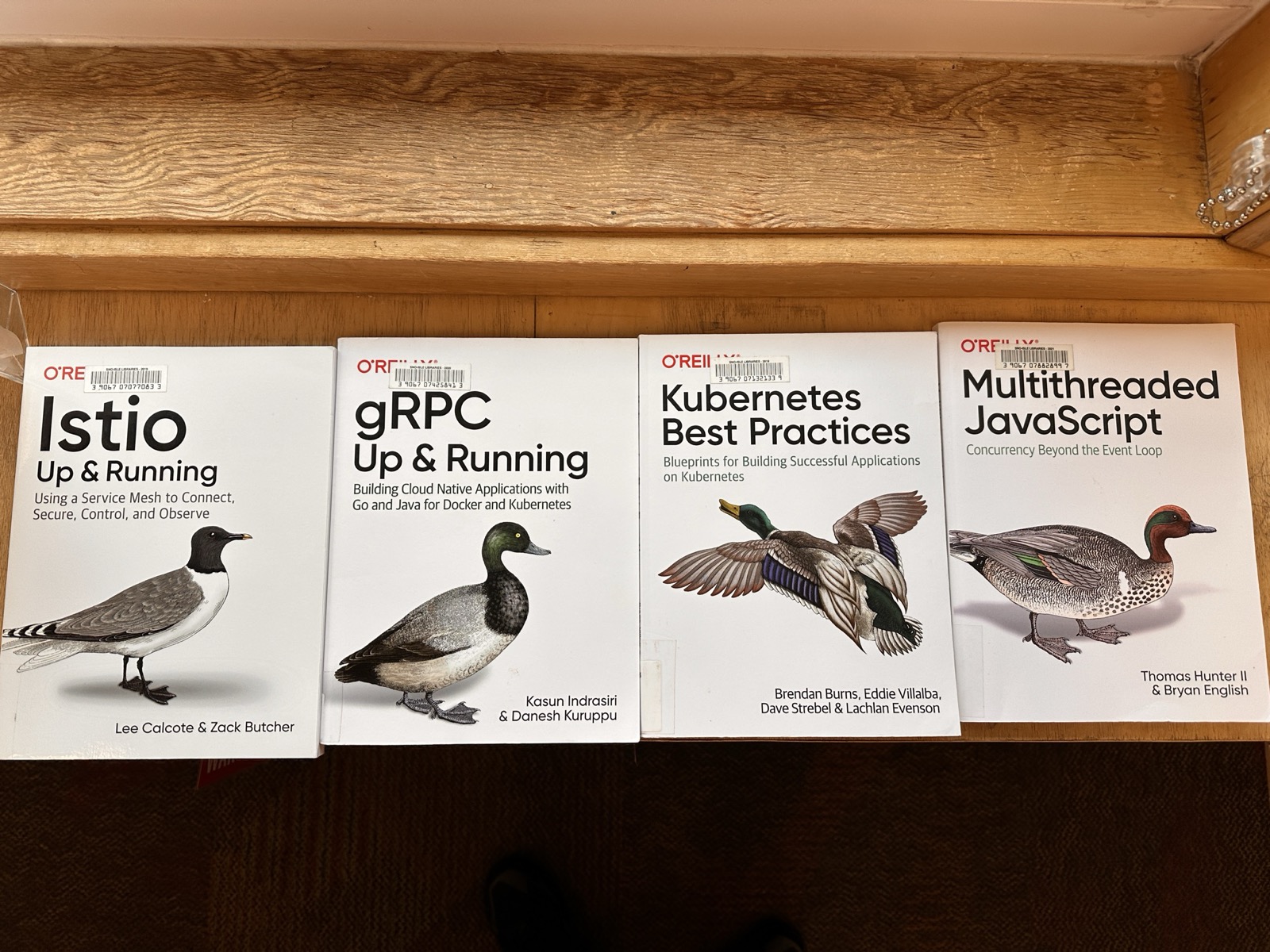
As I read the colophon of each book to understand more about the cover, I decided to dig deeper. This post describes what I found along these themes:
- a brief history of O’Reilly Publishing
- a comparison of the major tech book publishers: O’Reilly, Manning, and Packt, in terms of tech coverage, editorial quality, reading experience, latest/newest updates, authors’ tech authority, reader perception and recognition.
- the O’Reilly Learning Platform: how it differs from other tech knowledge subscription platforms. And how you can use your public library account to access the catalog.
- most importantly: the famous “animal covers”! How it started, how was it received, conservation awareness & partnership. I will also look at the most well liked covers.
Let’s jump in!
O’Reilly Books
A brief history
O’Reilly Media began in 1978 as a small technical‑writing consultancy and evolved into one of the most influential technology publishers and learning platforms in the world. The company moved from contract manuals to trade books in the mid‑1980s, built a reputation for authoritative Unix and Internet titles, and later expanded into conferences, web portals, and an online learning subscription (formerly Safari Books Online). Today O’Reilly is known as much for shaping tech culture (coining and popularizing terms like “Web 2.0”) as for its books.
Comparing with other tech publishers
The 3 biggest tech book publishers are O’Reilly, Manning and Packt.
 book from each of the big 3, side by side. A stark contrast between the O’Reilly animal cover and Manning’s antique character vibe
Among them, I enjoyed and learnt the most from O’Reilly’s books. They are opinionated in a helpful way, usually sharing industrial practices from the author’s own professional experiences, or interviews with top-notch practitioners. They are definitely not how-to guides that throw all the code at you (which some Packt books make me feel). Rather, they explain more the “why” than “how”. I find this absolutely essential in the modern AI-era. Facts and how-tos are easy to procure, but wisdom from years of industrial experiences and the acumen for making business tradeoffs are gems in a pack!
I find Manning to be second after O’Reilly in terms of content quality. The books I’ve read contain in-depth content around a concept or topic. Some do contain batterfield tips from the trench, like the Machine Learning System Design book. Compared with O’Reilly books, I do find the editorial quality of certain Manning books a bit lacking, with content that are repetitive across chapters or not really cohesive and tight. However, its free ebook offer is quite unique and helpful for those who want to read electronically, or keep e-notes of what they read.
Here’s a look at their offerings from different angles:
Coverage and catalog strategy. O’Reilly’s catalog grew from Unix and Internet foundations into a broad portfolio that spans systems, data science, AI, cloud, and design; the company also bundles books with video, live events, and interactive content on its learning platform. Manning tends to emphasize carefully crafted, pedagogical books (Manning’s “In Action” and “MEAP” programs are well regarded), while Packt’s model is to publish a very large number of titles quickly to cover emerging niches.
Editorial quality and reading experience. Readers and community discussions commonly rate Manning and O’Reilly above Packt on average for consistency in editorial polish and depth; Packt is often praised for breadth and speed to market but criticized for inconsistent editing and variable depth.
Authors and authority. O’Reilly’s roster includes many long‑standing practitioners and thought leaders; Manning similarly attracts authors who focus on teaching and deep dives. Packt’s rapid publishing cadence means more first‑time authors and shorter turnaround, which can be an advantage for bleeding‑edge topics but a risk for depth and polish.
Here’s a quick comparison of the 3 publishers:
| Attribute | O’Reilly | Manning | Packt |
|---|---|---|---|
| Tech coverage | Broad, deep; strong in systems, data, AI, web, ops | Focused strengths in data, backend, and practical developer books | Very broad; chases hot topics quickly |
| Editorial quality | Generally high; long editorial cycles for flagship titles | High; careful editing and pedagogy | Mixed; faster production, more variability |
| Reading experience | Authoritative, reference + narrative balance | Hands‑on, tutorial style with clear learning paths | Often pragmatic and example‑driven; variable polish |
| Latest/newest updates | Frequent new editions and early‑release titles on platform | Regular new editions; strong in emerging data/AI topics | Rapid churn to cover trends quickly |
| Authors’ tech authority | Many established experts and practitioners | Many academics and practitioners with deep domain focus | Mix of experienced authors and newer contributors |
| Reader perception and recognition | High brand recognition; many “classic” titles | Respected for teaching and clarity | Seen as accessible and affordable but hit‑or‑miss |
If you want canonical references and a curated learning path, O’Reilly and Manning are safer bets. If you need a quick, inexpensive book on a very new tool or niche, Packt often has something available sooner.
Learning Platform
Core Features of Subscription model
The subscription-based Learning Platform contains the following features:
- Extensive catalog. Access to tens of thousands of books, video courses, conference videos, and interactive content from O’Reilly and partner publishers. The platform aggregates books, early‑release titles, and multimedia learning assets.
- Learning paths and playlists. Curated learning tracks, playlists, and “academies” that group content into skill journeys.
- Live events and interactive content. Live training, Superstreams, interactive sandboxes, and labs (availability depends on plan and licensing).
- Searchable answers and AI chatbot. Platform features that let learners search across books and videos for quick answers and code snippets, or chat with AI to extract information from different books.
- Offline reading and mobile apps. Mobile apps with offline downloads and sync across devices (availability depends on plan and licensing).
Compare with other tech subscriptions
Depth and curation vs. breadth and community content. O’Reilly emphasizes curated, publisher‑grade content and long‑form books plus video; platforms like Pluralsight or Udemy emphasize video courses (often instructor‑produced) and community uploads. O’Reilly’s strength is the combination of reference books, early‑release manuscripts, and live events in one place.
Publisher integration. Because O’Reilly is itself a publisher, the platform includes first‑party titles and early‑release access (MEAP/early access), which is different from aggregator platforms that license third‑party video only.
Enterprise features. O’Reilly offers enterprise analytics, team learning paths, and reporting for organizations — positioning it as a learning‑and‑development tool as well as a content library.
Access with Public library accounts
Library access democratizes high‑quality technical learning: students, job seekers, and lifelong learners can use the same resources that enterprises pay for, often at no cost beyond a library card. This has become a major channel for community upskilling.
In the Puget Sound area, the Seattle Public Library provides free access to O’Reilly’s complete catalog for library card holders. Once you login, you will be able to access
- curated playlist (group related chapters from different books around a theme)
- short classes
- full catalog (books including early release titles, videos, and selected interactive content)
However, a library subscription is different from a paid individual subscriptions. For example, as a SPL patron, I cannot save favorites and progress. For other libraries, you might not be able to view some live events, access certification exams, interactive labs or have mobile app access.
Conservation: The animal covers
This is the fun part!
Let’s take a look at the start of the animal covers, how they are received, and cultural/environmental impacts they produced.
Origin and design choices
The animal covers began in the mid‑1980s when Edie Freedman (then a freelance designer) proposed using antique Dover woodcut engravings of animals to give O’Reilly books a distinctive, humanizing identity. The idea grew from the quirky names of Unix tools and languages — terms that felt as odd as exotic animals — and the historical but less factually accurate engravings, which provided a visual voice that set O’Reilly apart on bookstore shelves. Early covers were black‑and‑white woodcuts; over time the program evolved to include color and commissioned illustrations while retaining the engraved aesthetic.
Public reception
The Menagerie is indexed on the O’Reilly site for browsing.
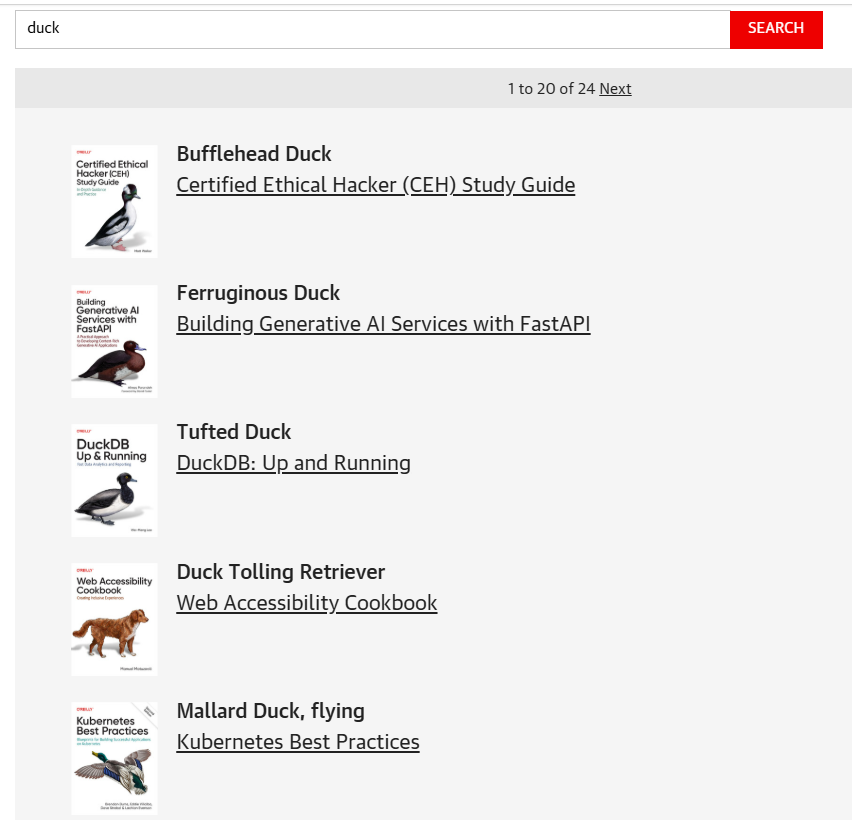
Brand recognition. The animals became a visual shorthand: readers often refer to books by their animal (for example, “the Polar Bear book” for Information Architecture for the World Wide Web). That cultural glue helped O’Reilly titles become part of the rituals of learning and hiring in tech, building a recognizable, consistent brand across thousands of technical titles.
Community affection and cult status. The animal covers did more than brand books. They made technical content feel less sterile, created a shared visual language across disciplines, and gave readers a playful way to talk about resources. Several covers have achieved near‑cult status within subcommunities. A few examples:
- Polar Bear (Information Architecture) is widely referenced by UX and IA practitioners.
- Python and Perl covers (elephant, camel, owl, etc.) have become iconic within their language communities.
- The tarsier image from Learning the vi Editor became an early emblem for the brand.
Merch, memes, and cultural life. The animal art has been repurposed into posters, stickers, and memes; developers collect covers and sometimes display them as a kind of professional badge. As the designers remain cryptic of the choices, people have constantly been 2nd-guessing the story behind it, adding to the lore. The company even published a coloring book of O’Reilly animals.
Raising awareness and partnerships
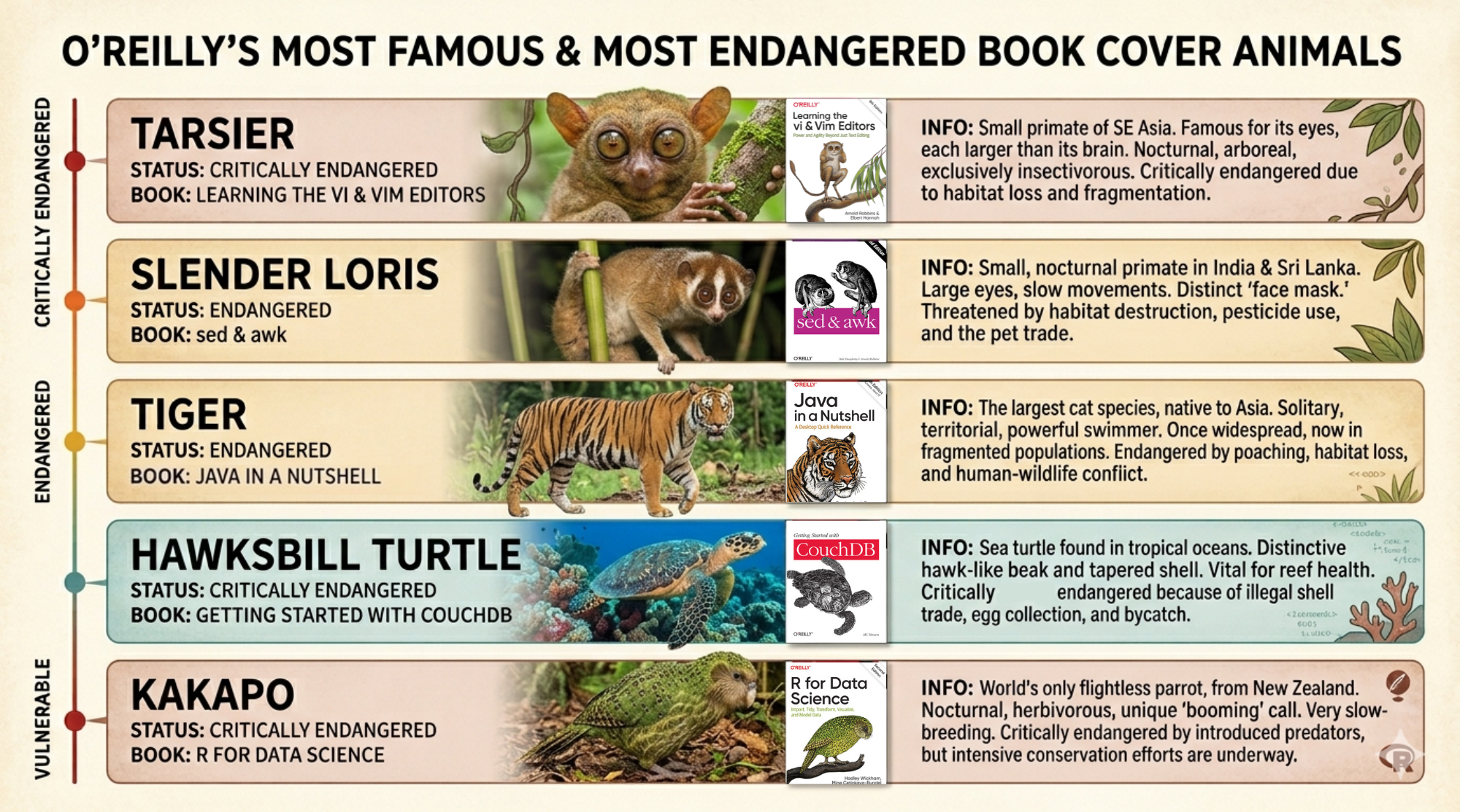
The animal covers spark interest and raise awareness among tech audiences about biodiversity and species risk, even if O’Reilly’s primary mission remains publishing. That organic curiosity has nudged some readers toward conservation resources and conversations.
Over the years readers and data‑minded community members noticed that many of the animals depicted are rare or endangered.
That observation inspired projects that extracts the animal list, cross‑reference O’Reilly’s menagerie with conservation status (for example, community analyses that query IUCN statuses for cover species). Another project convened concerned software engineers with eco-background to collaborate on conservation projects using their technical skills.
Most popular covers
Polar bear, elephant, camel, tarsier, and several birds and primates appear frequently in community lists and social posts. Popularity often correlates with the book’s influence: seminal titles that shaped a field tend to make their animal cover more famous.
A handful of covers have become shorthand for entire disciplines (the “Polar Bear book” for IA, certain bird covers for R/data books). The combination of a beloved title and a memorable animal image is what creates cult status.
Recommendations
O’Reilly’s influence in tech is a mix of content, community, and culture. Its books taught generations of engineers, its conferences shaped conversations, and its animal covers turned technical manuals into a recognizable, humanized brand.
Among the 3 major publishers, choose along:
If you want canonical, well‑edited references and a curated learning path: start with O’Reilly or Manning. O’Reilly is especially strong when you want a mix of deep books, videos, and live events in one subscription.
If you need the newest, niche topic covered quickly and affordably: check Packt, but vet the book sample and reviews for editorial quality. Community feedback often flags Packt’s variability.
If you’re cost‑sensitive or learning through a library: see whether your public or university library offers O’Reilly access — it’s frequently available and gives you a surprisingly complete learning stack without the individual subscription price.
With that said, I’ll head back to reading/building, and looking forward to befriending more animals!