Although this post contains locale-specific suggestions, the general theme should be equally applicable to other US regions.
As a resident in the Washington state, we are blessed with a very diverse landscape and equally a rich mix of birds. My last post described my inroad into the intriguing world of birding. In this post, let me share some practical tips for budding birders in the Puget Sound area of the Pacific Northwest. I will go over:
- the benefits of birding for every age group
- what should I bring to a birding trip?
- where and when to go birding?
- is there a group where I can join to start?
- what other resources can I consult to jumpstart this hobby?
As I am fairly new too, I will share what I learnt along the way so you will spend less time prepping and more fun time outdoor!
Why Birding?
The first thing that comes to my mind is the beautiful yet complex world of birds. Not only are their plummage gorgeous, but to understand them deeper, you would be drawn into a system of habitat, food supply, behaviors, lifecycles and dependency on other creatures. The pandora’s box is open and soon you’ll learn a lot in different areas.
But it needn’t be complicated. You can just go out and enjoy a relaxing walk in the park, soaking in much needed fresh air and sunlight, while sharing the time with our avian friends around. Just hearing their songs, watching them flying above in different patterns can be a de-stressing routine for busy individuals. And just like in hiking, any so-called analog activity that pulls us out of our cocoon of sitting and dwelling in an online world can help us reconnect with something much bigger than our own existence.
Birding is also family friendly and inclusive. It’s very kids-friendly, in fact, my Audubon chapter hosts a lot of kids-oriented activities to instill a sense of awe for nature in kids. For those with less than perfect stamina, many of the birding spots and group outings are fairly assessible, with most walks on flat trails or even with stationary viewing from the parking lot!
I also find the hobby therapeutic. For those recovering from a physical or mental trauma, the sense of being in touch with so many lively creatures around, and witnessing a robust and resilient circle of lives around us, gives one a strong dose of wonder, energy and vitality to move forward.
Those who can’t put down their camera lens will also find birding a rewarding venue to unleash their creativity.
As if this is not enough, a recent study claims that birding might improve brain capacity and prevent aging. It is indeed an intensive activity if you are really into it, because you have to do pattern matching and memory recall while being extremely aware of what’s happening around. When I take into all the available cues and retrieving what I’ve seen before, read in guide books and taught by senior birders, it really feels like I’m in a flow! It both feels good and makes like I just went through a mental gym!
What to bring
All we need are our eyes, although a pair of binoculars definitely helps to magnify (puns intended) your enjoyment. But to start off, don’t rush to buy any equipment. Rather, borrow a binocular kit from your local library (if available), and for longer ranges, go to a group outing where the trip leader will let you view from their scopes. In these outings, you will bump into a lot of more experienced birders that can give you advice on what to purchase. By doing so, you can get a sense of the different equipments and see how they work in the field before locking down your choice. Or you can attend an equipment event like what Eastside Audubon and Kenmore Camera host regularly, to try out everything in an intensive session!
To decipher the spec and numbers, head to the National Audubon Society’s binocular guide. After developing a sense of the metrics, check out their recommendations, which does newbies a great service of breaking down their recommendations by budget.
As a newbie myself, I borrowed from the library first, and talked to trip leaders and fellow members to see what they use. I found a pair of 8x42 binoculars to be the perfect balance of magnification and view. Here’s my take of the other variations:
- 8x25: The field is very narrow, making it hard to find birds or track their movement in flight
- 10x42: 10x sounds good as you get more magnification at roughly the same cost as 8x. But I cannot hold it still and the extra vibration means bad image regardless of the optics quality, and headaches, which means a shorter day out.
Heeding the advice of Neil English and other forumers, I settled on the SV202 ED 8x42 binoculars.
The other thing to keep in mind is to bring extra coats to an outing. Always be prepared to dress warmly and minus the forecast by a few degrees. Birding locations are often fairly exposed (waterfront, or flat field) and subject to strong winds. For winter migratory birding, I find wool hats, neck gaiters, gloves and thermal clothings such as Heattech a must for a comfortable trip.
As we are guest to the birds, the environment and people who call the land home, we also need to maintain good ethics while being out there. The Be Bird Wise program in the Skagit area provides responsible practices that are easy to understand and adopt.
Lastly, bring a sense of curiosity to the field. As a new birder, we are still not yet acclimatized to their habitats and the whole ecosystem. Which translates to: birds can appear in places we least expected, and thus bring us lots of pleasant surprises and joy!
Where to go?
Start with your backyard and neighborhood parks. Don’t discount them and shoot for exotic places initially. As you familiarize with your native habitats and their avian residents, move to the following locations.
Puget Sound locations
The Puget Sound Area offers a diverse range of birding opportunities, from the urban landscapes of Seattle to the natural reserves of the Olympic Peninsula. Here are some highlights for birders in the region:
- Discovery Park (Seattle): 534 acres of varied habitats (forests, beaches, meadows) with 270+ species.
- Nisqually National Wildlife Refuge (Olympia area): Located at the delta of the Nisqually River, it is prime for viewing migrating shorebirds, waterfowl, and raptors, featuring a popular boardwalk through salt marshes. Find a nearby national refuge here
- Union Bay Natural Area (Seattle): A 74-acre site with over 200 bird species recorded near the University of Washington.
- Washington Park Arboretum (Seattle): Offers extensive, easily accessible birding trails.
- Marymoor Park (Redmond): A mix of lakeshore, wetland and forest settings.
- Juanita Bay Park (Kirkland): Good for spotting wetland species such as herons, and various waterfowl.
- The Locks in Ballard (Seattle): Great for spotting herons, eagles, and kingfishers.
- Marymoor Park (Redmond): Hosts an Audubon Bird Loop with a huge Great Blue Heron heronry.
- Waterfront in Edmonds: You can see seabirds up close from the fishing pier and marina.
- Dumas Bay Sanctuary (Federal Way): A protected nature preserve at Point Dalco for birding on the Sound.
- Sewage lagoons (wastewater treatment plants): I know you might say, “what?”. But flocks of wintering waterfowls take refuge in these ponds, especially when the tide is high or rough. The bonus is you are certain to find one near your municipality. Try the Brightwater (Woodinville) Everett, Marysville, Stanwood ponds. The last 3 are especially productive for winter birding. In my last couple visits, there were easily over thousands of ducks from various species. Everett and Marysville both have access trails outside a chain-linked fence and the odor can be unsettling at times. Stanwood feels more open (no fence) without any noticeable smell, but the site is much more windy.
Venturing out
For those who want to venture further north or south, the Washington Department of Fish & Wildlife has produced an educational map for all the wildlife viewing areas along the whole stretch of I-5.
Skagit Valley
A bit far up north is the legendary Skagit Valley, famed for its breathtaking beauty in spring (daffodils and tulips) as well as migratory birds in fall and winter. A mere 1.5 hours drive from Seattle will give you unbelievable views of trumpeter swans, snow geese, huge variety of ducks and shorebirds, as well as majestic raptors soaring above. As if this is not enough, you will also be able to take in Mount Baker, Mt Rainier, The Olympics mountains and the North Cascades range in the horizon!
Olympic Peninsula
- Dungeness National Wildlife Refuge (Sequim): Features a 5-mile sand spit with diverse habitats, serving as a critical spot for migratory waterfowl and coastal birds.
- Grays Harbor National Wildlife Refuge (Hoquiam): A vital stop on the Pacific Flyway, known for massive concentrations of shorebirds during spring migration. Ridgefield National Wildlife Refuge (Ridgefield): Known for wintering dusky Canada geese and varied wetland habitats, making it excellent for viewing raptors and waterfowl.
Chapter favorites
All the local Audubon chapters publish a list of their favorite spots. For example, in the Puget Sound area:
eBird hotspots
For finding real-time, user-reported sightings, use the eBird.org interactive map to explore “hotspot” in the area. eBird hotspots are publicly accessible locations that can range from parks and nature reserves to well-known trails. They are designated by eBird users, and aggregate sightings from multiple birders, providing a centralized source of information about bird presence, abundance, and seasonal patterns in a given area. By leveraging existing hotspots, new birders can quickly identify locations where birds are actively being seen, improving the chances of successful birding trips.
The Explore page also provides interactive maps showing hotspot locations worldwide, species checklists and recent sightings, photos and sounds from the Macaulay Library, and alerts for rare or notable species in your area.
In addition, the Birding Hotspots website complements eBird by providing crowdsourced tips, site descriptions, habitat photos, and trail information not always available on eBird. This resource is useful for planning trips and understanding local birding conditions. For example, the listing for Nisqually NWR describes the trails in details and recommends routes for those with limited time. It also provides location-specific information such as entrance fee, restroom availability, etc., that helps trip planning. All these are missing in eBird hotspot listings.
Important Bird Area
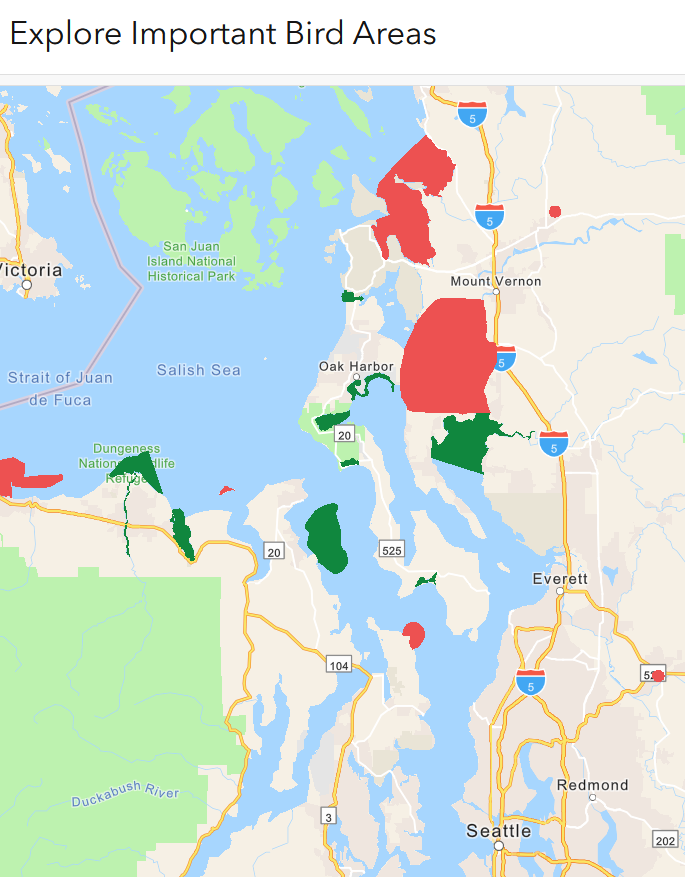
Audubon’s Important Bird Area project identifies sites that are the most essential for long-term conservation of birds, and to take action to ensure the conservation of these sites. In western Washington, key IBAs in western Washington include:
- Skagit Bay
- Samish/Padilla Bays
- Port Susan Bay
- Deception Pass
- Nisqually Delta
Guide Books
Other regional guide books I find helpful to pinpoint interesting locations:
- Birding in Snohomish County and Camano Island, 3rd Edition: published by the Pilchuck Audubon chapter, this is extremely detailed on each birding hotspots in the county
- Audubon Washington Birding Trail - Puget Loop: The Great Washington State Birding Trail is a network of seven distinct, map-based driving routes created by Audubon Washington to showcase the state’s diverse habitats and over 350 bird species. These routes, which include the Puget, Olympic, Cascades, and Sun and Sage loops, highlight premier, accessible locations for viewing. It features detailed color maps providing specific site information, habitat descriptions, and seasonal, timing advice.
- A Birder’s Guide to Washington: you can read it online or purchase a printed copy. The content is very detailed, with maps and species list for each area.
Birding hikes
For hikers, what better than combining both hobbies into a single adventure? The WTA has curated several trails that are productive for birding in different regions of Washington. And even better, they offer really good tips to start birding and think about conservation in the outdoors.
When to go?
In general, the 2 migration seasons (spring and autumn) will reward you with the richest varieties.
- Spring (late March to mid-May) is generally considered the best season for bird watching due to the massive influx of colorful migratory birds returning north, offering peak and concentrated diversity and activity, especially during April and early May.
- Autumn (September-October) is excellent for observing migration heading south
- Winter offers unique advantages like leafless trees for unobstructed views and concentrated waterbird populations in the Pacific Northwest.
- Summer allows for observing nesting behaviors and fledglings.
I began birding in early winter in Skagit county, which coincides with the migration pattern to the south. The massive amount of waterfowls, shorebirds and raptors in Pacific Northwest estuaries, wetlands and farmlands are just breathtaking, and makes me feel more blessed for calling this place home! Yes the weather can be cold, wet and windy, but you can always take a break in your car and refuel. The good thing about winter birding is because the locations are often very open without obstruction (trees are mostly empty by now, and the birds are usually out in the farm fields or water). This makes it much easier for a newbie to spot a bird with binoculars or scope. In addition, ducks and other shorebirds are relatively stationary, which make them easier for beginners to spot and observe. Therefore, I would suggest you start at this time to get used to the techniques and hone your ID skills.
When the weather warms up, these migratory birds will move back north to breed. There are some remaining residents, and the hobby will shift a bit back to forests to look for songbirds. This might be a bit challenging for beginners as these birds are speedy acrobats that dart between canopies. I do look forward to my first summer field trip though, as it will be cool to combine birding with mountain hiking in the gorgeous Cascades mountains.
Shall I join a community?
Each region has its own Audubon chapter, led by highly experienced and enthusiastic birders who are eager to share the joy of birding, and the importance of conservation for the whole ecosystem. Check out the National Audubon website for a chapter near you, and find a field trip to join.
You do not need to be a member to join a trip, and you are not obliged to only join trips from your nearest chapter. Different groups have different demographics and you might find one more “connecting” than the other. There’s no right or wrong answer to this. In fact, my first trip was to Wiley Slough offered by the Skagit Audubon Society, which is 1.5 hr from my home. I was super impressed by the welcoming attitude of the group, and the deep knowledge and passion of the trip leader that I immediately joined the Skagit Audubon Society afterwards. This again shows that it’s not just the birds, but humans matter tremendously in this AI-era!
Why join a community when you can venture out on your own, especially when the locations are so close to home and pose no risk like high up in the mountains? Well, I’d say it’s like having a guiding light in the dark. When you absolutely know nothing about the habitat and potential birds showing up, having an expert next to you will save you a lot of time from random scanning, and increase your enjoyment 10x by immediately pinpointing where and what to look. I am so lucky to start out with really experienced trip leaders who not just showed me where/what to look, but also took the time to explain to me his thought processes: the why and how he came to an identification. Coming from an engineering background and obsessed with first principles, this is exactly the kind of knowledge I crave for.
As one gradually gets more sightings and practices identification along experts, to have someone nearby to vet your initial ID, to confirm or rebutt and reexamine will help you grow your skills way quicker than going solo with only guide books. As I explained earlier, what matters is not the final ID, but the process of how you come up with initial candidates and gradually narrow it down with additional data and vetting.
Here’s a list of the Puget Sound local chapters and their planned activities. Find some places that stoke your interest and try it out:
Helpful Resources
Apps
In this mobile era, we have a lot of tools at hand to aide us in the field even when we are alone. I use these tools heavily:
- Merlin: this one rules by its sound and image ID feature, which is of tremendous help to newbies. You just let the app access your mic and it will discern all the calls/songs from your surrounding, or you can upload a photo you take to let it recognize what bird you just saw. I’d say the voice ID is more accurate than the image ID though, even when both also take into account your location/time to filter the most probable species. It also has a simple wizard that asks you a series of questions (bird size, color, when/where, habitat) and it will produce a list of possible birds. As Merlin is primarily an ID tool, the species description comes a bit short. For example, it lacks size, which is a key property I use to filter out candidates in the field. For this, I use the Audubon app.
- eBird: great for reporting your own sighting, or find birds by viewing the most recent sightings for nearby hotspots. Collectively, these sightings helps scientists to research and answer pressing conservation questions globally. The mobile app has limited features compared with web version. It restricts searching for the most recent 30 days, and it is hard to enter specific location in the search. If you’re confused by the features, take this free course.
- Audubon app: The species description is way more detailed than Merlin. The bird ID wizard is also more granular than Merlin (asking more questions to narrow down candidates). I also find its location/species search experience to be better than eBird. Still, it is restricted to searching for the most recent 30 days, as it is calling the same eBird API as the eBird app. You can also setup alert for a specific species within X miles of your location, and it will alert you if any sighting is reported.
- Sibley Field Guide app: This app has an edge over the others, in which it allows you to compare 2 species side by side on screen. I’ve seen my chapter members using it in every trip, to help less experienced birders distinguish some apparently minor differences in species and assist in correctly IDing.
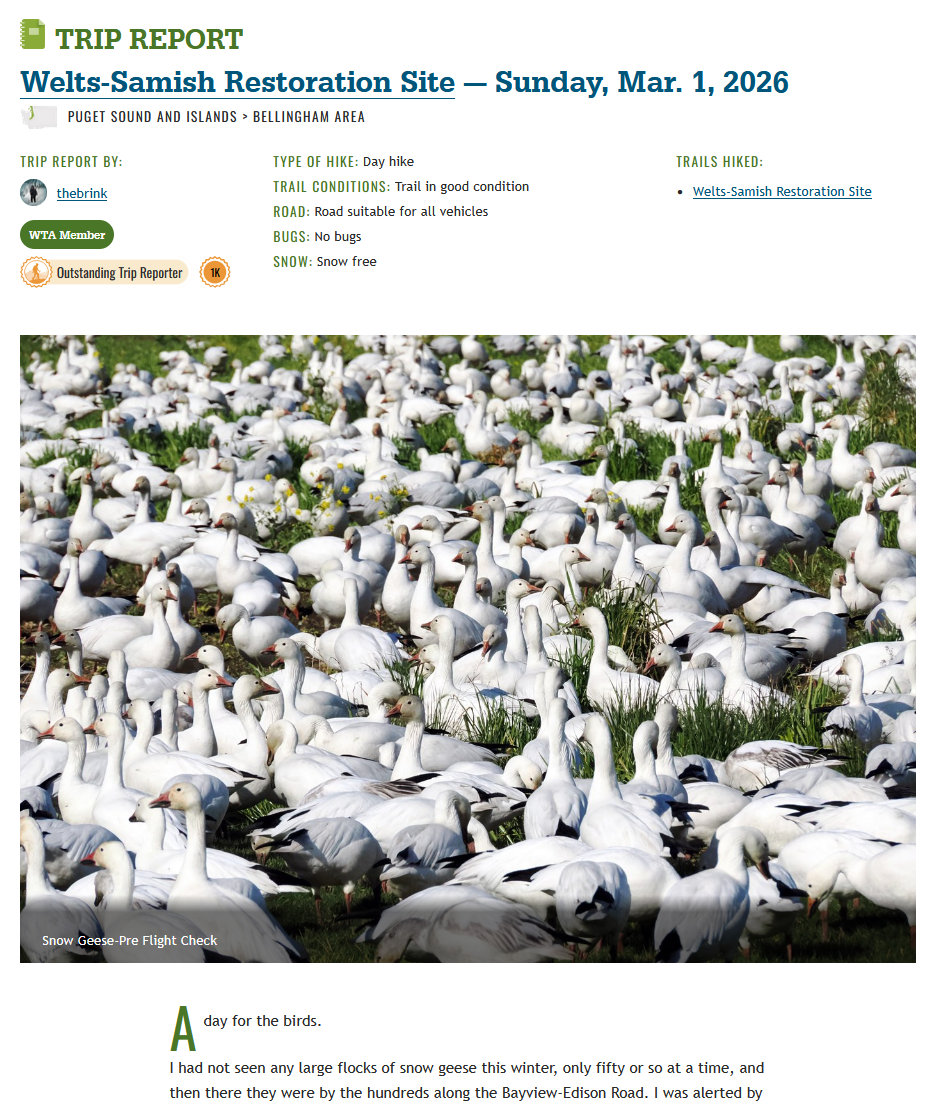
- Washington Trail Association app: Wait, aren’t we birding instead of hiking? Well, unless it is purely stationary in the parking lot, there might still be some type of walking. And a lot of the hotspots do have trails venturing out. I find the description of WTA spot on for many of the birding trails, and the latest reports from users complement eBird (which do not have much writeup) very well with photos of trail conditions. For example, look at this recent trip report on West 90, featured in WTA’s homepage. Isn’t it amazing with all the rich writeup and photos highlighting what/where to look? And if you scroll to check out the other trip reports, you’ll see that (as of this writing in late winter) nearly all are from birders!
- AllTrails app: same as above
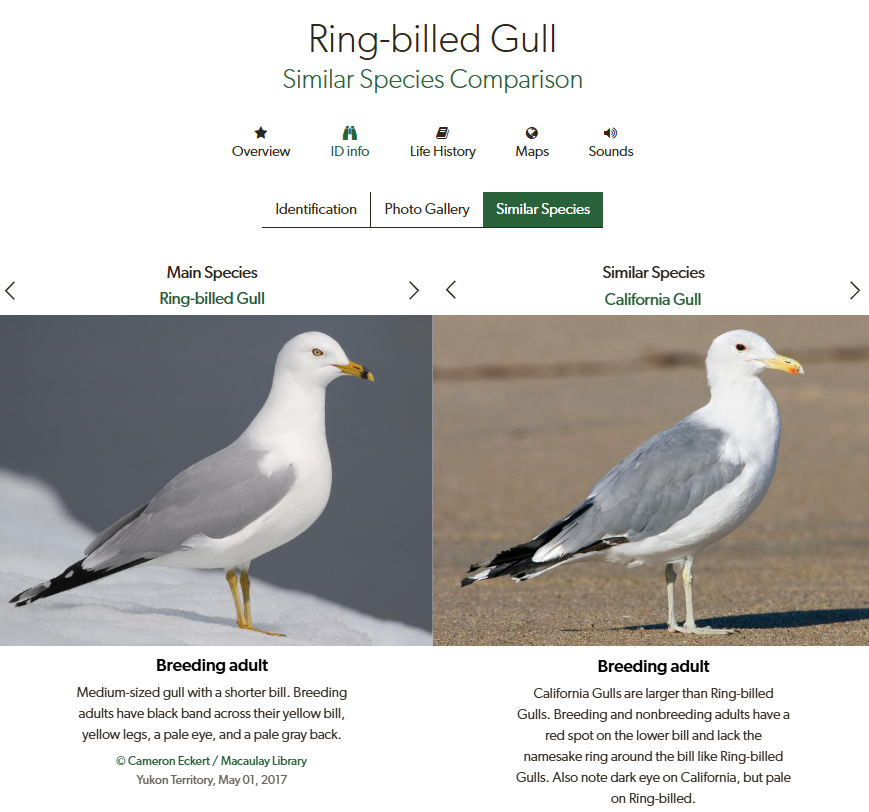
- All About Birds website: similar to a very good field guide, with facts on range, habitat, food, nesting, behavior, conservation status, species in the same family, and how to ID them. You can also find multimedia (photo, sound, videos) for each species. However, the most important feature for me as a newbie is the Similar Species, in which it calls out the major differences between 2 species of your choice using side by side photos.
Field Guides for ID
- Sibley Birds West: the de facto standard of guides. I love the illustrations, as it shows all the different angles, plus plummages in different time of year and age.
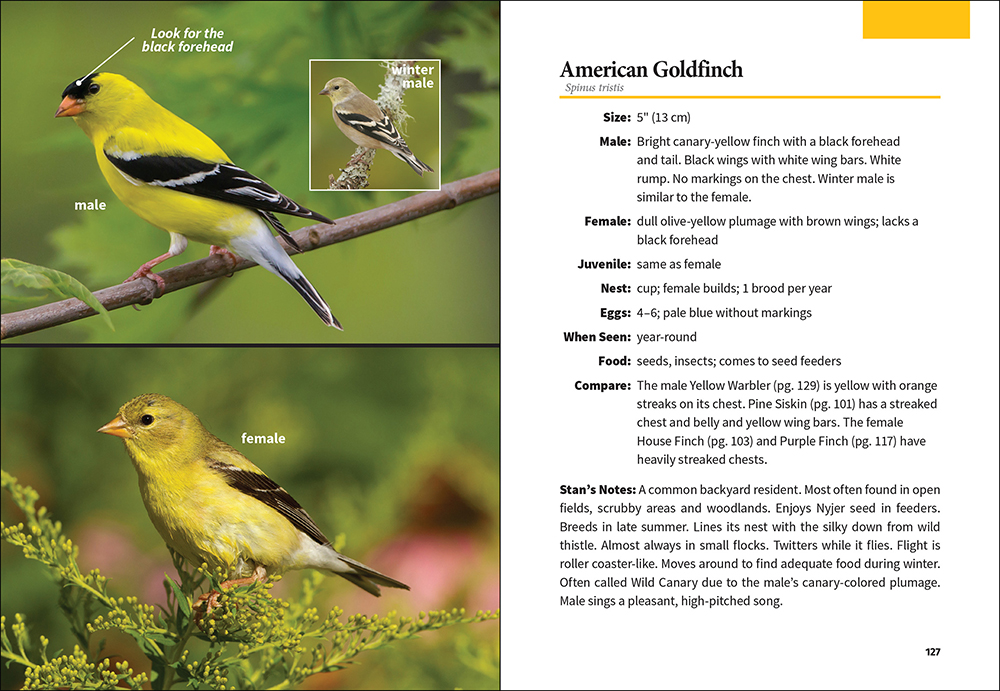
- Stan Tekiela’s Birding for Beginners: Pacific Northwest features an identification guide for common birds organized by color, with key identification marks, and naturalist notes (nest, eggs, favorite foods) for each bird. What I like it most is the “Compare” section, where Stan will highlight similar species and how to tell them apart. This is similar to the All About Birds “Similar Species” section, although this is straightly textual. Such differentiation content offers tremendous value to new birders as we are often tripped by apparently minor differences, especially when the lighting or viewing angle isn’t optimal. I just wish more phone apps can include this kind of information so we can use it in the field to tell birds apart.
Beginner Books
- Birding Basics: Tips, Tools & Techniques for Great Bird-Watching is both fun and informative for beginners. Noah is passionate with his hobby, not only will you find all the usual beginner tips on binoculars, birding basics, planning a trip, etc., but he infuses it with a lot of stories of how he started, the adventures along the way and things he is proud of.
- Identify Any Bird Anywhere: In 8 Easy Lessons by Kristi Dranginis: a book and online course teaching a system of “how to learn” birds. Rather than just memorizing field guide facts, it breaks down the ID process into 8 key modules—size, shape, posture, behavior, field marks, habitat, sound, and bird language, as explained on this Bird Mentor page (https://learn.birdmentor.com/identify-any-bird-anywhere-8-day-course).
Facebook Groups
- Pacific Northwest Birding: very active group with lots of daily postings. You can find out what people see around and help others ID birds.
Library Resources
Our local library systems never stop to amaze me with their high quality collection of materials and program offerings. Just look at this list curated by the Sno-Isle Library. It has books (for both adults and kids), videos, magazines and even free State Park pass! Talking about being comprehensive!
Conclusion
Birding is very low-pressure and flexible, in which you can customize your involvement the way you want it. It can be a “side dish” to your park stroll, a fun family activity, or you can really go deep into studying the multi-faceted science behind it. That’s why I find it fascinating, as everyone can find a comfortable home in this hobby. It’s also a hobby that can start at any age and grow with you.
As my birding skill grows, I aspire to be like my field trip leaders: to deepen my knowledge and share the joy of birding to more people, and to contribute in conserving this precious planet for both our avian friends and all other living creatures. I feel so blessed to coexist with so many of them, and I hope to share my joy of birding with you in one of our local hotspots one day!