In Part 1, we mapped the bioacoustics software ecosystem, evaluated memory constraints, and categorized tools by user personas.
Now, let’s explore how hardware engineers and conservationists navigate physical world deployment trade-offs.
The Core Constraints & Architectural Trade-offs
Designing edge systems forces you to balance three core constraints: Compute, Bandwidth, and Power. Every deployment choices sits along three fundamental engineering trade-offs:
- Bandwidth vs. Battery (Transmission vs. Compute): Leaving a cellular radio on to stream raw
.wavaudio kills battery power in hours. Running local AI inference uses battery upfront, but reduces transmission to a tiny 50-byte text payload ({"species": "Pileated Woodpecker"}) sent once daily. - General vs. Narrow Intelligence (Scope vs. Footprint): Running a 6,000-species global model requires a $45 Raspberry Pi and solar panel. Running a localized 350-species model on an NPU microcontroller runs for months on AA batteries.
- Continuous vs. Duty-Cycled Recording: 24/7 continuous recording catches fleeting calls at the cost of rapid SD card storage depletion. Decibel-based edge triggers conserve memory but risk missing quiet, distant calls.
Ultimately, these decisions dictate whether a project optimizes for real-time alerting or absolute data fidelity. Let’s look at the two distinct operational paradigms.
Architectural Paradigms in the Field
Architecture 1: Real-Time Edge AI (The “Alert & Act” Paradigm)
This approach shifts inference directly to constrained field devices, prioritizing immediate alerting over long-term raw audio retention. Data is recorded, classified locally, and discarded, sending only lightweight text payload indicating the presence of a species or threat. This completely bypasses the need for continuous internet connectivity and drastically lowers bandwidth demands.
- Canopy-Level Threat Detection: Rainforest Connection (RFCx Guardian) deploys solar-powered acoustic nodes using a two-tiered hardware design (microwatt MCU trigger + secondary AI inference processor). They detect illegal chainsaws, logging trucks, and gunshots in real-time, transmitting 50-byte SMS telemetry alerts via satellite directly to forest rangers.
- Offline Solar Sensor Networks: Sunbird AI in Kenya deployed fully offline solar IoT sensors in remote forests. Running on low-cost hardware like Raspberry Pis, these nodes execute a dual-model pipeline to classify species from ambient noise in under a second without cloud connectivity.
- Edge-Triggered Citizen Science: New Hampshire Audubon utilizes edge-triggered hardware like the BirdWeather PUC for passive backyard monitoring, pushing lightweight detection events directly to cloud maps over Wi-Fi without manual checklist entry.
Architecture 2: Two-Phase PAM (The “Survey & Discover” Paradigm)
Passive Acoustic Monitoring (PAM) prioritizes absolute data fidelity over real-time speed. Raw, uncompressed .wav audio is recorded onto SD cards over months. Physical media is retrieved later to run high-parameter desktop AI models and conduct manual verification.
- Hardware Loggers: The open-source standard relies on low-power devices like the AudioMoth ($90 unit running for months on 3 AA batteries) or weather-proof industrial units like the Wildlife Acoustics Song Meter featuring integrated GPS time-stamping.
- Community-Led Conservation: Supported by a $2M Bezos Earth Fund grant, the National Audubon Society’s Project “Escucha Aves” deployed the AI-powered ecoacoustic platform Chorus across reserves in Colombia, Peru, and Bolivia. Community groups operate the hardware and interpret localized AI insights from retrieved off-grid audio.
- Marine Baseline Surveys: The Arctic Passive Acoustic Monitoring initiative deploys submerged hydrophones anchored to the Arctic Ocean floor to record marine acoustic landscapes for months, running custom regional filter pipelines post-retrieval.
- Multimodal Pipelines: EcoChirp.AI processes field-retrieved AudioMoth data from the Sundarbans using Gemini to categorize soundscapes into Anthrophony, Biophony, or Geophony. Human threats trigger immediate security workflows, while biological sounds pass to site-specific finetuned BirdNET models.
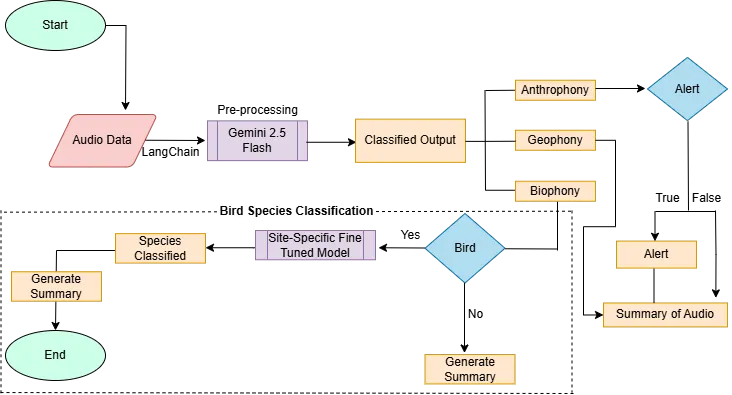
image credit: Google
- Computer Vision Extensions: Beyond sound, SeeBird (developed by Houston Audubon, Rice University’s Data to Knowledge (D2K) Lab, Audubon Washington, and Audubon Texas) automates waterbird colony counting from aerial drone footage. Their computer vision algorithm localizes species in complex coastal habitats, reducing manual counting bottlenecks by an order of magnitude, with a global release planned for 2027.
This presentation from the original Rice University student team illustrates how their computer vision algorithm successfully localizes and classifies different bird species in crowded, visually complex coastal habitats.
The DIY Standard: Building a BirdNET-Go Monitoring Station
For my immediate project to ID nocturnal migrants overhead, I decide to build a dedicated listening post. If you want a device to sit in the woods, identify birds locally, and never route audio through a cloud server, the DIY community standard are BirdNET-Pi and BirdNET-Go. Both deliver real-time and offline acoustic bird classification but differ in architecture, maintenance, and deployment. Here is how they compare, and how to build one.
BirdNET-Pi vs. BirdNET-Go Comparison
| Feature | BirdNET-Pi (Legacy / Enhanced Fork) | BirdNET-Go (Recommended) |
|---|---|---|
| Architecture | Bash / PHP / Python scripts installed on host OS | Single Golang binary with modern web UI; Docker-packaged & isolated |
| Hardware | Supports Pi Zero 2W–Pi 5 with light-resource optimizations. | Hardware-agnostic (Linux, Mac, Windows, Pi, x86) |
| Storage Impact | Historical SD-card wear (mitigated by RAM disk in forks) | Native RAM-first audio analysis; minimal SD wear |
| Audio Input | USB Mic / ALSA | USB Mic / RTSP IP Camera streams |
| Multi-Model | Coupled primarily to default BirdNET model | Supports simultaneous classifiers (e.g., Google Perch, Bat) |
Choose BirdNET-Go for low-maintenance/remote setups (Docker portability + less hardware wear + leverage IP camera audio streams). Choose the updated BirdNET-Pi fork for enhanced analytics, legacy compatibility, or deep HA integration if you’re comfortable with OS-level installs.
Bill of Materials (BOM)
At roughly $85–$115, you can completely replicate the PUC’s dashboard and automatic global map syncing using a Raspberry Pi or other Single Board Computer, but with the modern performance of a Golang backend.
SBC Compute: Raspberry Pi 4B (2GB/4GB recommended) or he cheaper Zero 2W. Or if supply is still not keeping up, try Libre.
Note: The Pi 4B is highly recommended for the AI processing load.
Storage: 32GB+ Class 10 MicroSD Card (~$10).
Audio Capture: USB Lavalier/Omnidirectional Microphone (~$15) or an existing RTSP IP camera stream.
Enclosure & Power: Weatherproof outdoor junction box (~$15) + USB-C Power Supply (~$10).
Optional Sensor: BME680 Environmental Sensor (~$15) connected via GPIO for Temp/Humidity/Pressure tracking.
Step-by-Step Installation
Flash Operating System: Use Raspberry Pi Imager to install Raspberry Pi OS 64-bit Lite. Pre-configure Wi-Fi credentials and SSH access.
Hardware Assembly: Mount the Pi in the junction box, route your USB microphone externally, and secure power connections.
Deploy BirdNET-Go: SSH into the Pi and execute the official automated install script:
curl -fsSL https://github.com/tphakala/birdnet-go/raw/main/install.sh -o install.sh && bash ./install.sh`Configuration & Biogeographical Priors: Access the web dashboard on your local network (http://
:8080). Complete the onboarding wizard to set up live audio streaming and location-based filters, enabling the AI to use biogeographical priors to drop geographically impossible false positives.
Database Migration (Optional): Existing BirdNET-Pi nodes can migrate historical data seamlessly using the integrated BirdNET-Pi2Go import utility within the dashboard.
My Build Roadmap
Applying product management principles to my personal bioacoustics stack results in two distinct project tracks:
Track 1: Backyard Nocturnal Alerting (Real-Time Edge AI)
Objective: Continuous monitoring of flight calls overhead with real-time alerting.
Architecture: Raspberry Pi 4B running BirdNET-Go connected via RTSP. Detections fire notifications (text or webhooks) or route telemetry into an observability pipeline (Prometheus + Grafana) to track temporal visitation trends.
Track 2: Remote Conservation Survey (Two-Phase PAM)
Objective: Tracking cryptic and rare species in off-grid habitats.
Architecture: Deployment of low-power AudioMoth loggers recording raw .wav files to SD cards, followed by local batch parsing using BirdNET-Analyzer and LyreBot for manual clip verification and optimal confidence scoring.
As a birder, we are unequivocally living in a golden age. We’ve gone from flipping through soggy Sibley guides in the rain to deploying our own monitoring station that extends our hearing range 24x7, and with a little artistic hacking, can make a beautiful wallpiece too!
Building your own edge bioacoustics station means you aren’t just a passive consumer of an expensive commercial gadget. You are engaging intimately with the data by downloading the specific acoustic signatures of local species, tuning an AI specifically for your locale, and deploying unobtrusive hardware that listens quietly without draining grid power. It brings instant species tracking, zero monthly subscription costs, total offline reliability, instant alert, and an incredible sense of active stewardship over the environment you monitor.
I’ve got my Arduino kit, a spare Raspberry Pi in the drawer, and a whole lot of nocturnal sounds to decode. Time to start assembling!